
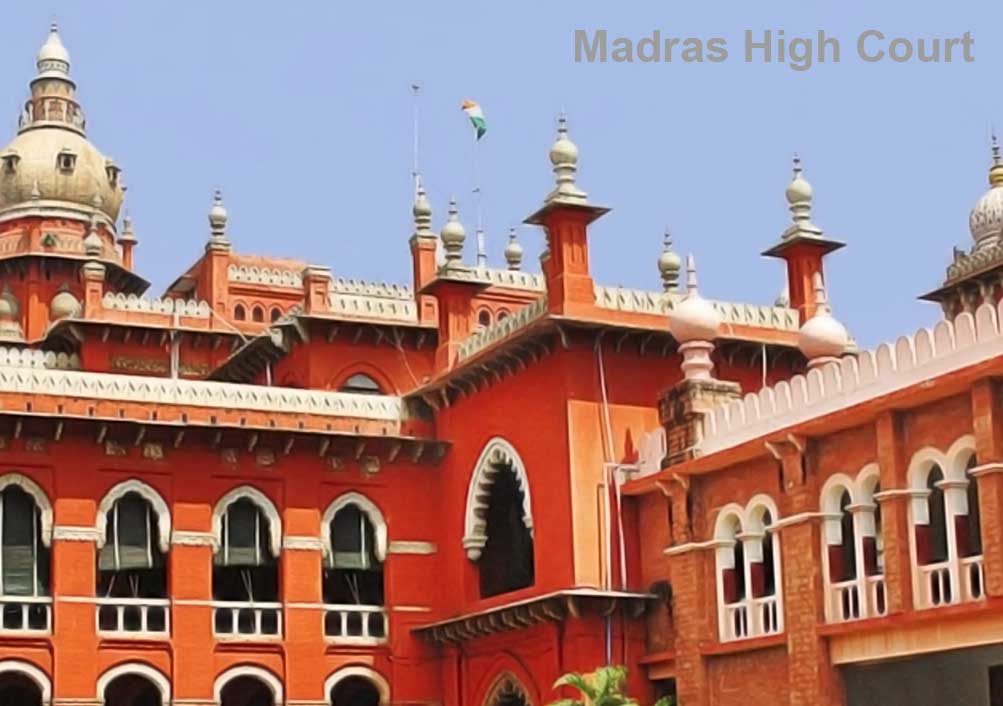
IN WA 4299 OF 2019 - MADR HC- Keeping a man in suspension eternally for over 10 years even after reaching superannuation without paying subsistence allowance is incorrect in law, thus continuation of disciplinary proceedings must be set aside: Madras High Court
Justice J. Nisha Banu and Justice D. Bharatha Chakravarthy [21-06-2023]
Read more: T. Retnapandian v. Tamil Nadu Cements Corporation Limited
Simran Singh
New Delhi, June 23, 2023: The Madras High Court has allowed an appeal against the order of the Single Judge which had upheld the disciplinary proceedings against the appellant considering the lapse of time of more than 10 years after retirement when the appellant was left without even payment of subsistence allowance lawfully due to him.
The Division Bench comprising of Justice J. Nisha Banu and Justice D. Bharatha Chakravarthy stated that the continuation of the disciplinary proceedings against him, especially when no charge was made out as per the Tamil Nadu Cements Corporation Limited Service Rules, the Single Judge, even though was right in rejecting the ground relating to the 6 months period, ought to have considered the grounds and facts and allowed the writ Petition.
In the matter at hand, the appellant challenged the direction to appear for the inquiry, on the ground of illegality and prayed for closing the disciplinary proceedings against him in respect of charge memorandum dated 14.7.2004. It was submitted that all the articles of the charge, and the imputations related to his wife indulging in private construction business pertaining to the income amounting to bribe and disproportionate wealth of known sources of income. Thus a criminal case was initiated, in violation of 5.2(v) of the said Rules which came into existence by amendment dated 15.07.1994. It was thus submitted that the charges were alleged to be in the year 1991-1992 which were consequently not covered under the said Rules.
The appellant relied upon Rule 2.22(b) of the said Rules which postulated that the retention of service for continuation of the disciplinary proceedings was only for a period of 6 months and continuation of inquiry beyond the period of 6 months was illegal. However the Single Judge Bench had held that the said period of 6 months was only directory.
It was further averred that the income from business could not be treated as an income which was known to the sources of income, and the criminal case had ended in the acquittal and the appeal filed by the respondents was also dismissed. It was submitted that when the appellant had superannuated as early as in the year 2011, no purpose would be served by continuing the disciplinary proceedings against him which was illegal in any event and therefore, he prayed for allowing the Writ Appeal.
The Bench agreed with the findings of the Single Judge that the said period of 6 months was only directory in nature and not mandatory. The purport of Rule 2.22(b) of the said Rule was to continue the disciplinary proceedings in extraordinary cases like that of the present case, where the delinquent employee attained the age of superannuation, pending the departmental proceedings.
The Bench noted that only in that view of the matter, since the employee had to be retained in the service by placing him in suspension, the period of 6 months was being mentioned. And only because, the department should not be financially burdened with the payment of subsistence allowance for a long period, with a view to complete the inquiry expeditiously, the period of 6 months was mentioned in the said Rule.
For the reason stated above, the Bench stated that the said Rule was only directory in nature. It was also made clear that if the employee was continued beyond a period of 6 months under suspension, then he would be entitled for subsistence allowance, notwithstanding the same period of 6 months mentioned in the said Rule for payment of subsistence allowance. “This position has been already clarified by several judgments of this Court in respect of the identical Rule in several other public sector undertakings in the State of Tamil Nadu…Therefore, when the appellant retired in the year 2011 itself, keeping him in suspension eternally for all these years, and not paying subsistence allowance is incorrect in law. We have rendered our finding with regard to the continuation of the disciplinary proceedings and since no specific claim was made by the appellant in this regard, he will not be entitled to the arrears of subsistence allowance.”
The Bench noted that the “ Rule itself has come into force only in the year 1994, and the instances mentioned in the statement of imputations of misconduct in Annexure-II, in I to X, all relate to the period 1991 to 1993, and therefore, the Rule itself is not applicable. The statement of imputations mentioned in XI to XII relates to the period 1995, and therefore, the Rule is applicable.”
The Bench was of the view that the appellant’s wife undertook to construct a house, and in one case the construction was completed, and in the other case, the construction was not even completed. In this regard, a careful reading of Rule 5.2(v) of the said Rule made it clear that it prohibited taking stockistships and forwarding agencies in the names of the family members or benami name was prohibited, and the employee could not carry out money lending or private business or trade or occupation. The private business or trade or occupation by the family member could not be said to be prohibited by the said Rule.
Consequently, the order of the Single Judge was set aside and the disciplinary proceedings were declared to be illegal. Further the respondents were directed to permit the appellate to retire from service and pay all the retiral benefits, within two months from the date of receipt of the copy of the order.
Legitquest is a Legal-Tech venture run by a versatile team of tech-savvy attorneys, engineers and designers who aim to make the practice of law simpler for its end users. We have eminent jurist Mr. Ram Jethmalani as our patron

Add a Comment