
In Crl Misc Appli 10855 of 2012 - GUJ HC- ‘Merely issuing notice for indiscipline would not tantamount to instigating employee to commit suicide,’ Gujarat High Court quashes FIR against higher officials of Rajkot Municipal Corporation
Justice Ilesh J. Vora [24-05-20223]
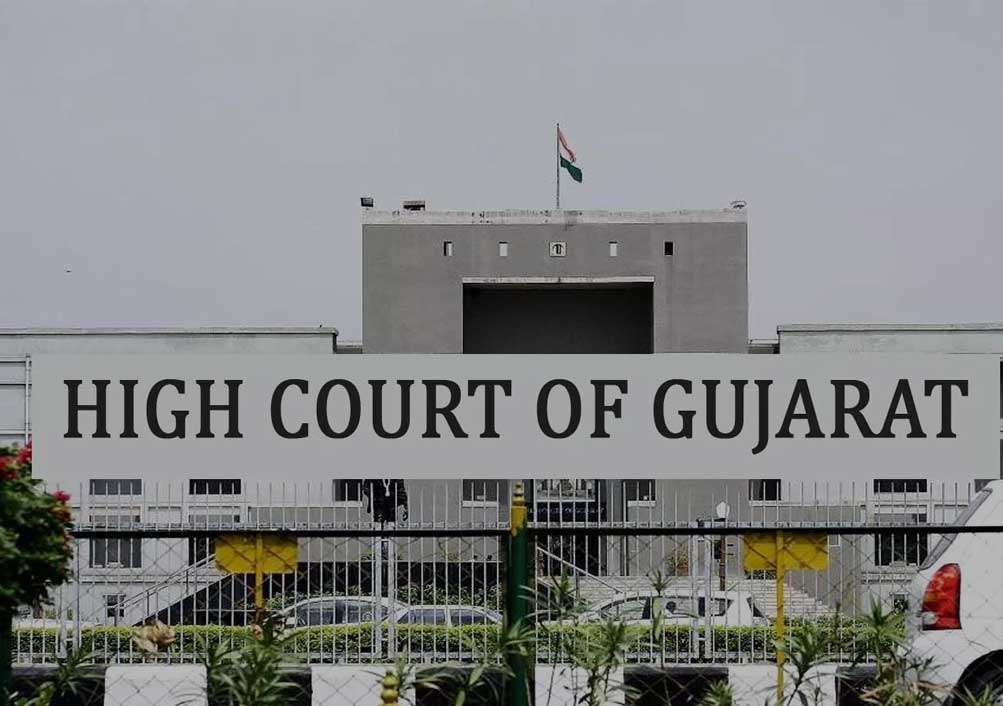
Read Order: Ashwinbhai Mansukhbhai Kanzariya v State of Gujarat
Simran Singh
New Delhi, May 29, 2023: The Gujarat High Court, while exercising its criminal jurisdiction, has quashed the FIR and the proceedings emanating thereof, for offences punishable under Section 306 and 114 of the Indian Penal Code, 1860 (IPC) and Section 3(i)(x) and Section 3(ii)(v) of the Scheduled Castes and Scheduled Tribes (Prevention of Atrocities) Act (Atrocities Act).
In the matter at hand, the deceased was an employee of Rajkot Municipal Corporation (RMC) who was dissatisfied with his transfer from Malaria branch to Drainage branch at Bedinaka, Rajkot thus was irregular in attending the office. Multiple Show Cause Notices were issued on different dates and the authority concerned after considering the reply thereof, accepted his explanation and closed the matter and whatever leave was sought by the deceased was sanctioned in accordance with applicable rules and regulations.
He committed suicide on 04-07-2012 by hanging himself in Hotel Miracle at Ahmedabad stating in his letter that the applicant-accused being higher officials of the department intentionally insulted him in front of other employees and intimidated with an intent to humiliate and harass him as he belonged to scheduled castes, thus, holding them responsible for the act of suicide. He further stated that he was victimised by the higher officials and illegally served with show- cause notices for which he was compelled to submit a false reply thereof and had been directed to work in other field, which was not befitting to his qualification and job experience. It was further alleged that the Drainage department where he was transferred was totally new for him and did not have any work experience to do the work of cleaner on the heavy vehicle which was meant for maintenance of drainage work etc. and working as a cleaner with such vehicles was dangerous to his life. He further alleged that he along with others had strongly opposed the transfer from Malaria Department to drainage branch, Bedinaka, Rajkot. He also strongly urged that his letter be treated as his complaint towards the commission of suicide and further alleged that after his transfer at drainage branch, he was asked to work as a sweeper without any written order.
Issue for consideration was the whether the contents of the FIR and suicide notes as they stand, made out an offence within the meaning of Section 306 of IPC and provisions of the Atrocities Act ?
The Bench noted that the entire prosecution case was based on the suicide note in form of letter dated 28-06-2012 which was address to Police Commissioner, Rajkot written by the deceased in his own handwriting, whereas, second one dated 04-07-2012 was written by him before the incident, which ran into 6 to 7 pages. Upon pursuing both the aforementioned suicide notes, it was evident that the deceased was in great stress and depression and had decided to end his life.
The Court navigated through Section 306 IPC which stated that if any person committed suicide, whoever abets the commission of such suicide, would be liable to be punished. Further Section 107 of IPC defined abetment by way of 3 clauses:
- instigating a person to commit an offence or
- engaging in a conspiracy to commit it and/or
- intentionally aiding a person to commit it
Thus, stated that the prosecution must prove the elements of mens rea i.e. guilty mind of the accused.
The Bench noted that the order of transfer was not passed by any of the applicant-accused nor was there any allegation that they played an active crucial role in his transfer. In such circumstances, the allegations that he was asked to work as a sweeper or in a lower cadre could not be accepted.The anguish expressed by the deceased in two suicide notes was clearly established by the act of his suicide and that he wanted to take revenge against the higher officials. Since the order of transfer, the deceased was irregular in attending the office and remained absent for about 72 days for which notices to resume the office were served by the Dy. Engineer. In such circumstances, merely issuing the notice and/or memo for indiscipline, would not tantamount to inciting or provoking or instigating the deceased to commit.
“There is no any allegation that the deceased was continuous harassed and insulted deliberately without justifiable cause or reason. A simple act of issuing notice or memo for the irregular attendance of the deceased, for which he was otherwise duty bound to serve the department, would definitely not amount to abetment of things as defined under Section 107 of Indian Penal Code. What emerges from the suicide notes is that, deceased was protesting his transfer, for which the applicants having no role to play and after his transfer, considering the job assigned to the deceased, it cannot be said that he had been assigned the work of lower category.”
The Bench stated that it was not only the deceased alone who was transferred from one department to another but in total 16 persons were transferred by the Dy. Commissioner, RMC.
“The act of suicide is not the remedy for the deceased. He could have ventilated his grievance before the Commissioner or Dy. Commissioner of RMC. It is not in the hands of the applicants to retransfer the deceased. Thus, on careful examination of the suicide notes, it appears that the deceased was very emotional and sentimental person and due to his posting to another department, he could not taken it in a positive way.”
Thus, considering the aforesaid aspects, the Court stated that the applicants had no intention to drive the deceased to commit suicide and they could not anticipate the same. “To bring home the applicants for the charge under Section 306 of Indian Penal Code, the intention and mens rea are main ingredients of the offence of abetment and they are lacking in the present case.”
The Bench was of the view that the contents of the suicide notes and allegations levelled in the FIR were not sufficient wherefrom an inference of the applicant-accused having abetted commission of suicide by the deceased may necessarily be drawn. Mere allegation of conspiracy or harassment would not be sufficient to raise the inference about the abetment of suicide. Thus, the Court was in complete agreement with the contentions raised by the applicant-accused that the contents of the FIR and allegations levelled in the suicide notes as they stand did not make out an offence within the meaning of Section 306 of IPC.
The Court was convinced that the continuation of the proceedings against the applicant-accused would amount to harassment and abuse of process of law and Court. For the foregoing reasons, this Court was of prima facie view that the ingredients of abetment as laid down in Section 107 was completely absent in the facts of the case and as such, Section 306 of IPC was not attracted.
The Bench noted that, on account of invocation of Section 306 of IPC and considering the caste of the deceased, the police had invoked the provisions of Atrocities Act. When the charge under Section 306 of IPC prima facie was not established, the charges under Sections 3(i)(x) and 3(ii) (v) of the Atrocities Act were also not made out.
With the above observation, the Court stated that this was a fit case where extraordinary power was required to be reinvoked to quash the FIR and other consequential proceedings thereof.
Legitquest is a Legal-Tech venture run by a versatile team of tech-savvy attorneys, engineers and designers who aim to make the practice of law simpler for its end users. We have eminent jurist Mr. Ram Jethmalani as our patron

Add a Comment